
PTCE Practice Test, 10 Free Questions With Answers
12 min read ·
Where can I find a free PTCE practice test?
PTCB itself doesn't offer a free PTCE practice test. Its official tools are paid, the Practice Bank at $65 and the Pre-PTCE mock exam at $29. For free practice, PTCB Quiz Prep has a 90-question, 110-minute full mock, RxTechExam has a free 50-question test with no login, and Pocket Prep gives 60 free questions. Free tests suit early practice and finding your weak domains. The Pre-PTCE suits a final check, because it uses retired PTCE questions and reports your score on PTCB's 1,000 to 1,600 scale. Ten worked questions are below.
What a PTCE practice exam should match in 2026
A practice exam only helps if it looks like the real one. Here is what PTCB says the PTCE is right now.
- 90 multiple-choice questions. 80 are scored and 10 are unscored. PTCB says the unscored ones are randomly placed and not identified, so treat every question as if it counts.
- 1 hour 50 minutes of exam time. The full appointment is 2 hours, with a 5-minute tutorial before and a 5-minute survey after.
- A scaled score from 1,000 to 1,600. The pass mark is 1,400.
- In person only, at Pearson test centers with a live proctor.
That works out to about 73 seconds per question. Any full-length practice test you take should run on that clock.
The four domains and their weights
The current PTCE Content Outline from PTCB is headed "Effective January 6, 2026". Its footer says "v1.4 August 2024". If that mismatch made you wonder whether you downloaded the wrong file, you didn't. It's the version PTCB links from its CPhT page, and other candidates noticed the same thing.
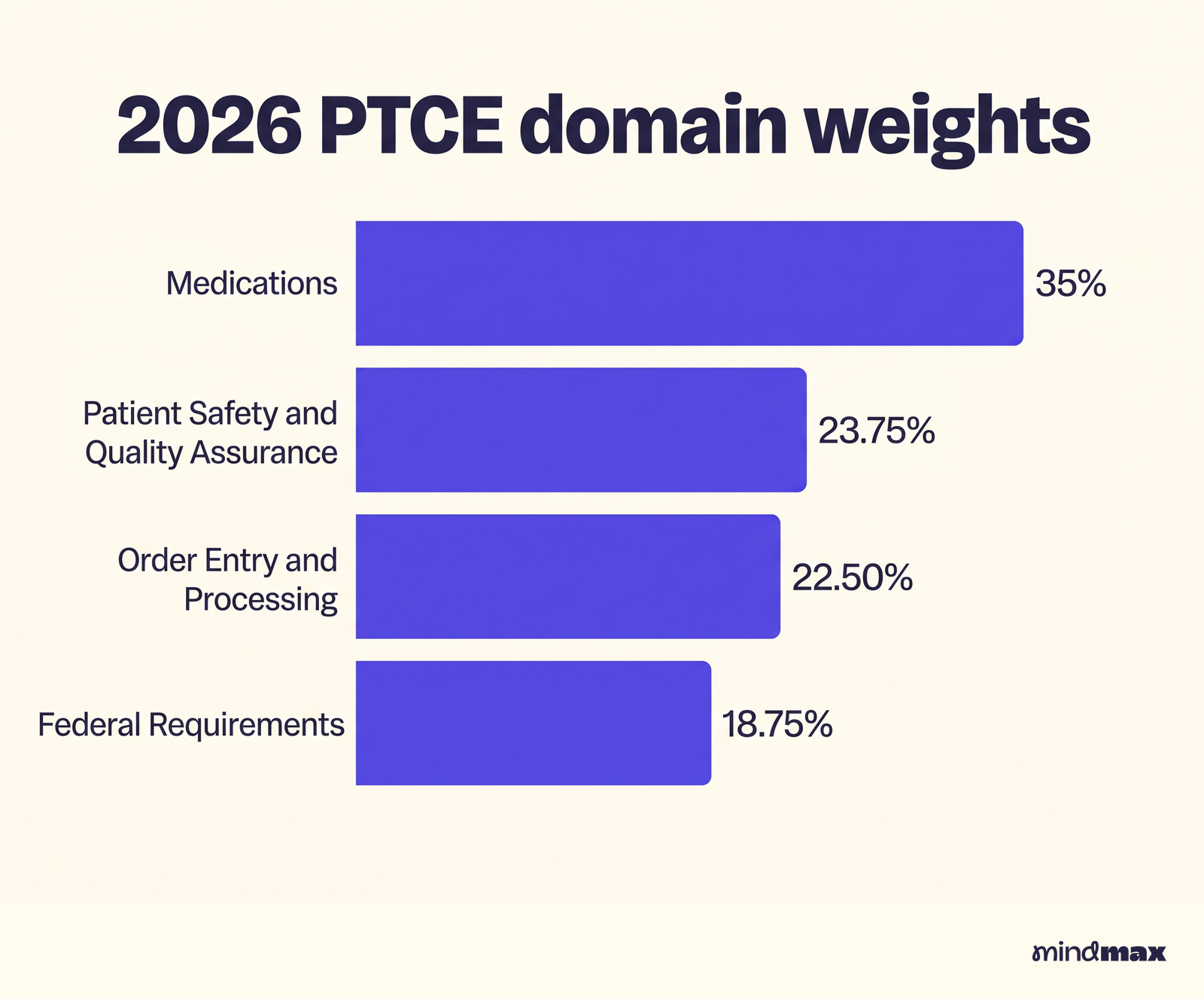
These are the 2026 PTCE domain weights.
| Domain | Share of exam | Approx. scored questions (of 80) |
|---|---|---|
| Medications | 35% | 28 |
| Federal Requirements | 18.75% | 15 |
| Patient Safety and Quality Assurance | 23.75% | 19 |
| Order Entry and Processing | 22.50% | 18 |
PTCB doesn't publish question counts per domain, so the last column is approximate. Some prep sites apply the percentages to all 90 questions instead and get slightly higher counts.
Math isn't a domain of its own. The outline marks calculation-based items in all four domains, including strengths and doses, drug stability, controlled substance prescriptions, pseudoephedrine and REMS, pharmacist intervention, prescription errors and the order entry calculations. So expect numbers to show up well outside Order Entry.
For the full picture of eligibility, fees and how the exam works, see our guide to what the PTCE is and how it works in 2026.
10 PTCE exam questions with answers
Try each one before you read the answer. These are written to the 2026 outline, grouped by domain.
Medications
1. A patient's amoxicillin suspension was reconstituted at the pharmacy. How long does it last after mixing?
- A. 7 days
- B. 10 days
- C. 14 days
- D. 30 days
Answer. C, 14 days. Drug stability for reconstitutables is its own outline item, and it carries calculation weight, so you may also be asked to work out a discard date.
2. A patient filling a prescription that contains acetaminophen also buys an over-the-counter cold product containing acetaminophen. What is the main concern?
- A. A drug-laboratory interaction
- B. A therapeutic duplication
- C. A storage problem
- D. A recall
Answer. B. Two products with the same active ingredient is a therapeutic duplication, which is outline item 1.2. It also sets up the next type of question, a total daily dose that runs too high.
Federal Requirements
3. How many refills can a C-II prescription have?
- A. None
- B. One
- C. Five within six months
- D. Unlimited within one year
Answer. A. C-II prescriptions cannot have refills.
4. A C-IV prescription is written with refills. What is the federal limit?
- A. No refills
- B. Two refills within 30 days
- C. Five refills within six months
- D. Eleven refills within one year
Answer. C. C-III and C-IV prescriptions are limited to five refills within a six-month period.
5. Which federal requirement covers product serialization, tracking, tracing and quarantining suspect products?
- A. REMS
- B. The Drug Supply Chain Security Act (DSCSA)
- C. MedWatch
- D. FDA recall classes
Answer. B. DSCSA is item 2.6 and is new to the outline. If a practice bank has no DSCSA questions at all, it was likely built for the older version.
Patient Safety and Quality Assurance
6. A prescription reads acetaminophen 1,000 mg every 4 hours. What should the technician do?
- A. Fill it as written
- B. Reduce the quantity on their own
- C. Flag it for the pharmacist
- D. Change the directions to every 6 hours
Answer. C. Every 4 hours is six doses a day, so 6,000 mg daily. That is above the 4,000 mg adult maximum. Spotting it is your job, deciding what to do is the pharmacist's, and that line is exactly what item 3.3 tests.
7. Why is "1.0 mg" an error-prone way to write a dose?
- A. The trailing zero can be misread as 10 mg
- B. It uses a Roman numeral
- C. It lacks Tall Man lettering
- D. Milligrams are not an approved unit
Answer. A. Trailing zeros, and missing leading zeros, sit with Tall Man lettering and bar codes under error prevention, item 3.2.
8. A patient reports a reaction after a vaccination at your pharmacy. Which reporting system is built for vaccine adverse events?
- A. MedWatch
- B. VAERS
- C. RCA
- D. CQI
Answer. B. VAERS is for vaccines, and MedWatch is FDA's general adverse event program. RCA and CQI are quality processes, not reporting systems for patients' reactions.
Order Entry and Processing
9. A 2.5 mL bottle of eye drops has 20 drops per mL. The sig is 1 drop in each eye daily. What is the days supply?
- A. 20 days
- B. 25 days
- C. 50 days
- D. 12 days
Answer. B. The bottle holds 2.5 × 20 = 50 drops. One drop in each eye is 2 drops a day, and 50 ÷ 2 = 25 days. The trap is forgetting "each eye" and answering 50.
10. The sig reads 1 tablet t.i.d. for 10 days. How many tablets do you dispense?
- A. 10
- B. 20
- C. 30
- D. 40
Answer. C. t.i.d. means three times a day, so 3 × 10 = 30 tablets. Sig codes, Roman numerals and days supply all fall under item 4.1.
Free and paid PTCE practice tests compared
When you need more PTCE exam questions than ten, these are the main sources, with prices as each provider states them.
| Source | What you get | Price |
|---|---|---|
| PTCB Practice Bank | 300+ former PTCE questions and 400 flashcards. Timed or untimed, choose length and difficulty, progress dashboard | $65 |
| PTCB Pre-PTCE | One full simulation using retired PTCE questions, with answer explanations and a score report by area | $29 per exam |
| PTCB Quiz Prep | Free 90-question, 110-minute full mock, a 45-question half mock, domain quizzes and math, Top 200 and abbreviation quizzes | Free, plus a paid course |
| RxTechExam | Free 50-question test from a 150-question bank labeled with 2026 knowledge areas. No login, no email | Free |
| Pocket Prep | 2,000 questions with Mock Exam, Weakest Subject and Missed Questions modes | 60 questions free, then from $15.99 a month |
A few things to know about each.
- The official tools are the only real PTCE questions. PTCB says Practice Bank users score 10% higher on average, and that candidates who pass the Pre-PTCE are 3 times more likely to pass the PTCE. You save $10 if you buy the Pre-PTCE with your CPhT application.
- PTCB Quiz Prep is the strongest free option for full-length timing practice. It says your first test each week needs no sign-up. Its math quiz still lists alligation, so skip those items.
- RxTechExam is quick to start and shows its full bank with explanations. Its bank leans heavily on Order Entry, with 54 of 150 questions, so it doesn't mirror the exam's weights.
- Pocket Prep has the biggest bank and a pass guarantee of 3 extra months of Premium if you don't pass. Some of its exam info text is out of date, such as saying you have 2 hours. The exam itself is 1 hour 50 minutes.
If you want practice built around a study plan, MindMax has a PTCE course written to the 2026 Content Outline. It sets a daily plan toward your exam date and includes a timed mock exam of 90 questions in 110 minutes. Its 70% pass mark is the app's own, not PTCB's.
Is PTCE Quizlet worth using?
Yes, for flashcards, not for practice exams. Candidates on Reddit use Quizlet for the Top 200 drugs, brand and generic names, sig codes, conversions and Roman numerals. That's memorization work, and flashcards are good at it.
Quizlet isn't a full-length exam simulation, though. Sets are made by other users, so many were built for the pre-2026 outline. Before you study a set, skim it for alligation or compounding cards and for old weightings. If it has them, use it only for the drug names and abbreviations.
How to use practice scores to judge if you're ready
This is where most candidates get confused. PTCB publishes no conversion from percent correct to scaled score, and only 80 of the 90 questions count. So a percentage on a third-party test is a guide, not a prediction.
Follow PTCB's own order
PTCB recommends the Practice Bank first and the Pre-PTCE as a final check after studying. It also says that because there's only one form of the Pre-PTCE, taking it more than once isn't advised. A sequence that fits that advice looks like this.
- Free domain quizzes to find your weakest areas early.
- PTCB Practice Bank, working through all of it so you don't see repeats.
- Full-length timed mocks at about 73 seconds per question.
- Pre-PTCE once at the end, when your other scores are steady.
What the numbers mean
PTCB Quiz Prep suggests aiming for a consistent 80% or better on full-length tests. That's a provider's rule of thumb, not a PTCB pass mark. PTCB only says 1,400 passes.
The Pre-PTCE is the one practice test reported on PTCB's 1,000 to 1,600 scale, and candidates say it tracks closely. Here is how two candidates' Pre-PTCE and real exam scores compared. One scored 1,558 on the Pre-PTCE, studied two more weeks, and scored 1,558 on the real exam. Another scored 1,583 on the Pre-PTCE and 1,562 on the real exam. Both cleared the pass mark of 1,400 with room to spare.
Don't trust one source
One candidate was averaging 98% in every category on the Practice Bank, then scored 70% on the Pre-PTCE, saying the questions were completely different. Another was worried after bombing third-party tests that turned out nothing like the real exam. The lesson is to mix sources and look at the pattern, not one score.
How to spot outdated PTCE practice material
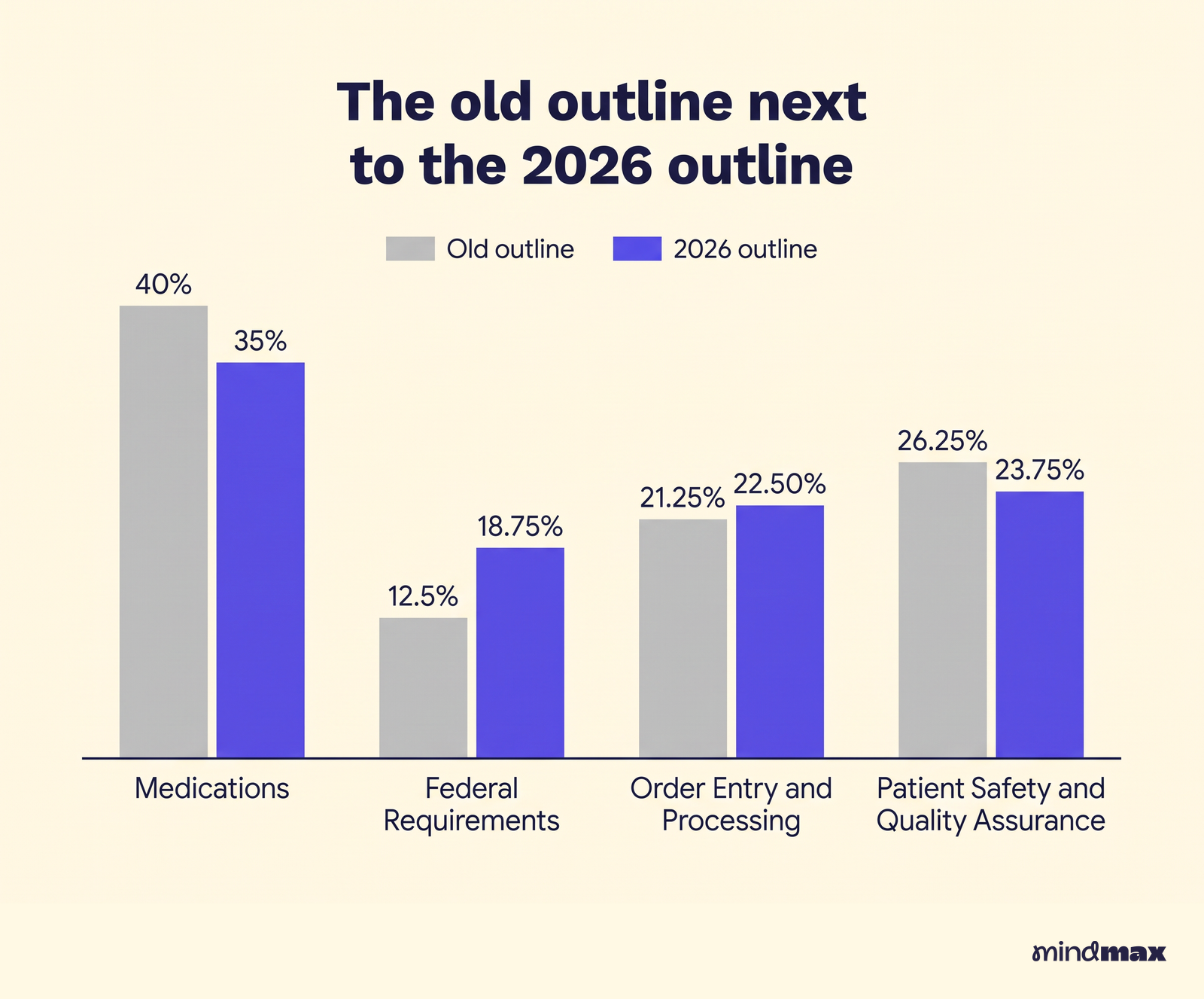
The 2026 outline changed the weights and the topics, and a lot of free material hasn't caught up. Prep providers report the old weights as Medications 40%, Federal Requirements 12.5%, Order Entry and Processing 21.25% and Patient Safety and Quality Assurance 26.25%. Here is the old outline next to the 2026 outline, and the biggest shift is the jump in Federal Requirements.
The same providers say non-sterile compounding was removed and DSCSA was added. The current outline has no compounding knowledge area and doesn't mention alligation.
Skip or set aside material with any of these.
- Alligation questions
- Non-sterile compounding topics
- Medications at 40% in its blueprint
- No DSCSA questions in the federal section
Federal Requirements now carries 18.75%, so give the DEA schedules, controlled substance handling, pseudoephedrine, REMS and recalls real study time.
Before you book the real exam
The PTCE costs $129 per attempt, and you pay again for each retake. You must wait for your official score report before reapplying, which arrives in your PTCB Account within three weeks. There's no wait before a second or third attempt, but a fourth needs a 6-month wait. PTCB's 2025 pass rate was 69% across 49,253 exams, so passing practice tests first is worth the time.
PTCB also links a free Pearson tutorial that previews the testing screens, which is a good way to see the interface before test day.
Frequently asked questions
Is there a penalty for guessing on the PTCE?
A prep provider, PTCB Quiz Prep, says there is no penalty for guessing. PTCB's own CPhT page doesn't state this, so check the official page before you rely on it. Either way, answer every question, since a blank can't earn credit.
Do you get a calculator on the PTCE?
PTCB Quiz Prep says an on-screen calculator is provided. PTCB's CPhT page doesn't confirm it, so check with PTCB or Pearson before test day. Practice your math both by hand and with a basic calculator so you're ready either way.
Can I take the PTCE online from home?
No. PTCB offers online testing for its other credential exams but not for the PTCE. You take it in person at a Pearson test center with a live proctor, and you should arrive 30 minutes early.
How many questions can I get wrong on the PTCE and still pass?
PTCB doesn't publish a raw cut score, only the scaled pass mark of 1,400 on a 1,000 to 1,600 scale. Some prep providers estimate you need roughly 70 to 75% correct, but that is not official. Ten unscored questions are also hidden among the 90, so counting misses on test day won't tell you much.
How long do I have to take the PTCE after I'm approved?
PTCB gives you a 90-day authorization window from approval to schedule and sit the exam. You can buy an extension for $20 per 90 days, up to two, but only before the window ends. If it expires without testing, you forfeit your fees and need to apply again.